
TAMSK Game Review
Related Products
Project GIPF is a series of eight abstract strategy games designed by Chris Burm. Each game has a hexagonal playing area and involves reducing the number of pieces or mechanics of the playing area. The way they approach these elements is not only unique, but also combines what I think are the best qualities in most theses: simple rules that reveal a complex game.
If you've never heard of Project GIPF, GIPF , TAMSK , ZÈRTZ , DVONN , YINSH , PÜNCT , TZAAR , and LYNGK , I encourage you to look them up in cardboard form or digitally online. They are worth your time.
Today's game: TAMSK
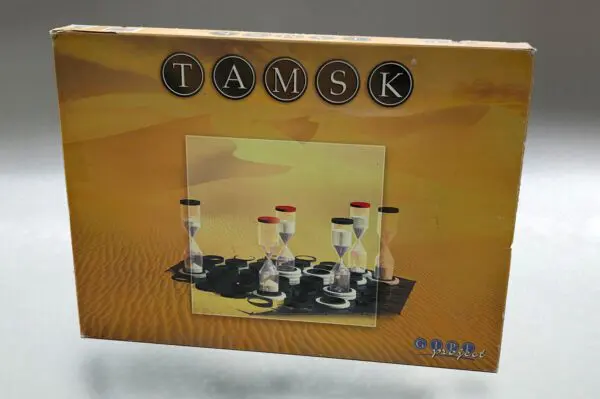
Before I begin, I know some supporters may object to including TAMSK here. This is because in 2007, when Broome introduced TZAAR , he stated that it would replace TAMSK in the GIPF project. fine. When you write a review about a GIPF project, feel free not to mention it. Having played TAMSK, I know it deserves a mention every time a GIPF project comes up.
That's because TAMSK , a game about balancing the falling sands of time against a rapidly shrinking board, is a great game. Great game.
GAME PROCESS
The game takes place on the hexagonal black field located between them. Each player has three hourglass timers; one takes the black timers and the other takes the red timers. You will also have 32 white rings.
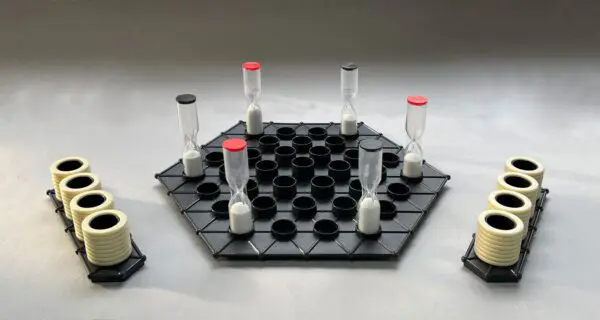
At the start of each turn, you'll take one of your three hourglasses, flip it over and place it in any available pipe next to where it started. You will then place one of your rings on top of the hourglass where it will fall around the tube that holds the hourglass. As soon as one player places the hourglass in the tube, the next player can move. They don't have to wait for the ring to sweep through the hourglass just played.
When a tube has rings equal to its height, that tube is out of play. This means that the outermost trumpets can only be played once, the second "ring" of hexes can be played twice, and so on.
For an hourglass timer to remain in play, it must always have sand from the top half to the bottom. If the hourglass runs out of sand at the top, it freezes on the board. The pipe he is standing in is blocked until the end of the game.
The game continues until neither player can make any additional moves because their timers have run out of sand or they have no valid moves. Again, the winner is the one with the fewest rings at the end of the game.
CONCLUSIONS REGARDING THE GAME
When the taller pipes are toward the center of the board, the gameplay will naturally move toward the center. However, the outer edges can be good places to quickly drop rings in an attempt to block your opponent's hourglass. (Remember that a frozen hourglass cannot move and therefore will not help you get rid of the rings.)
By introducing real-time as a game mechanic, players are forced to quickly assess their hourglass, their position on the board, the position of their opponent's hourglass, the areas where their hourglass can be trapped, and how you can catch one of your opponents. sand clock. All in a fraction of a second.
With varying degrees of 3-minute hourglass, there is no time for analysis paralysis in TAMSK.
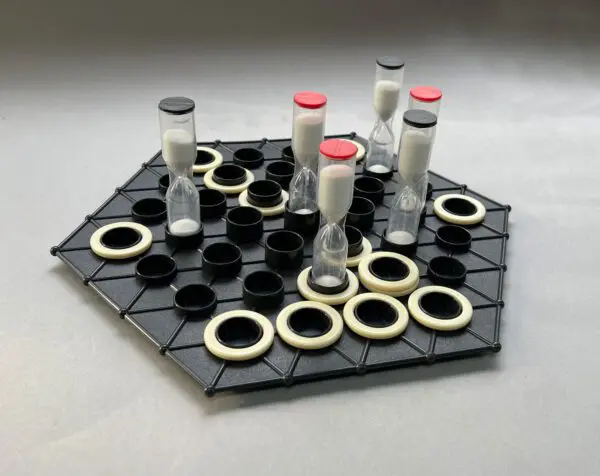
TAMSK is the only game I play standing up. Too much is happening too fast for me to sit and feel like I can take it all in. It's also the only abstract strategy game that gives me an adrenaline rush.
True, this type of game is not for everyone. I once played TAMSK with a friend who, at the end of the game we were playing, said, “I play games to relax and take my time between turns. I never want to play that again."
Personally, I will play it when I can. It's a fast-paced game similar to Speed Chess, except you don't hit the timer after making a move—the timers are your playing pieces, and you have to manage them both in time and place.
TAMSK was removed as an official game in Project GIPF mainly due to production costs. As a result, it has been out of print for years and is hard to find. However, if an exciting abstract strategy game sounds intriguing, then this Pluto from the GIPF project is worth your time.


