
Starfinder Player Core Overview
Related Products
STARFINDER PLAYER CORE REVIEW
The original release of Starfinder in 2017 had its fair share of growing pains. Complaints about the complexity and disconnected feel of starship combat, multiple Armor Class values, and issues with scaling skill check difficulties are just some of the criticisms I've heard over the years.
In response, Paizo launched one of its largest open playtests last August: the Starfinder Second Edition Playtest. The feedback gathered and the changes made as a result eventually led to the release of Starfinder Player Core at Gen Con 2025.
We received a copy of the book ahead of its official release, so let's take a look at some of its most interesting features.
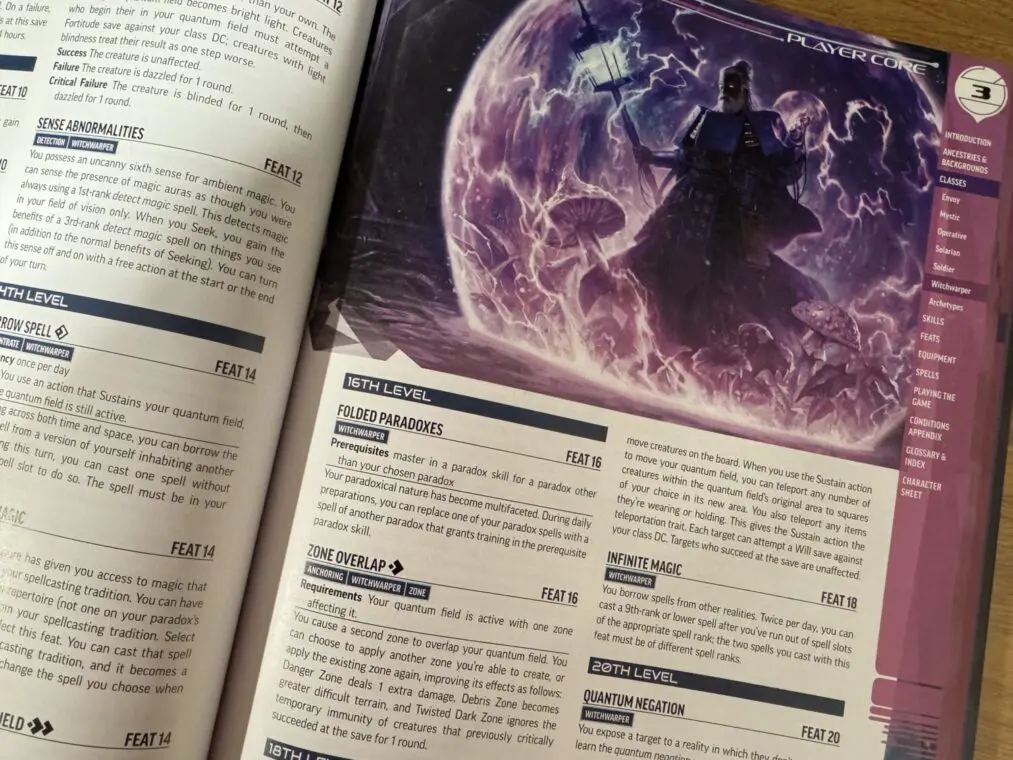
WHAT IS IT?
The primary goal of Starfinder Player Core is to bring the rules of Starfinder Second Edition in line with the existing Pathfinder Second Edition system, making the two games compatible. Bards rocking out on electric keytars in zero gravity? Skittermanders sitting shoulder to shoulder with goblins in an Alkenstar tavern? This release expands the possibilities for both games, although it remains to be seen how well elements from one system will work when combined with those of the other.
One of the first things players will notice when opening the book is that the character creation section has more than doubled in length, growing from three pages to approximately seven. I distinctly remember my reaction to the three-page character creation section in Starfinder First Edition: a surprisingly compact set of step-by-step instructions. However, the expanded section in Starfinder Player Core doesn't mean the process has become more complicated. Paizo has simply added essential information about ability scores, character sheet diagrams, and additional explanations so players don't have to constantly flip through the book looking for the rules they need. The result is a process that remains simple and straightforward, allowing players to move from character concept to the gaming table as quickly and efficiently as possible.
Thanks to the enormous amount of material accumulated over the lifespan of Starfinder First Edition, the new Starfinder Player Core offers an impressive 12 ancestry options right from the start, compared to just seven in the original Core Rulebook. This trend continues throughout the book's 455 pages, with players receiving a noticeably wider selection of feats, spells, and other options from day one.
The biggest difference between Starfinder Player Core and the previous edition is that the book contains only six starting classes. Unfortunately, fans of the Technomancer and Mechanic will have to choose another class for now, but this is only temporary. Playtesting for these two classes concluded at the end of May, and they will appear in a future publication. Both classes share a strong focus on interacting with advanced technology and machinery, so releasing them together makes perfect sense. Meanwhile, the Witchwarper has joined the starting class lineup, giving players a broader selection of magic-focused classes right from the beginning.
Thanks to the alignment with Pathfinder Second Edition's rules, Energy Armor Class is finally a thing of the past! Energy Armor Class (EAC) and Kinetic Armor Class (KAC) have now been combined into a single Armor Class (AC) value. This change alone significantly simplifies both the rules and equipment. Having to track two different defensive values and constantly check which one applied depending on the source of damage was an unnecessary hassle, so I'm genuinely glad to see it gone.
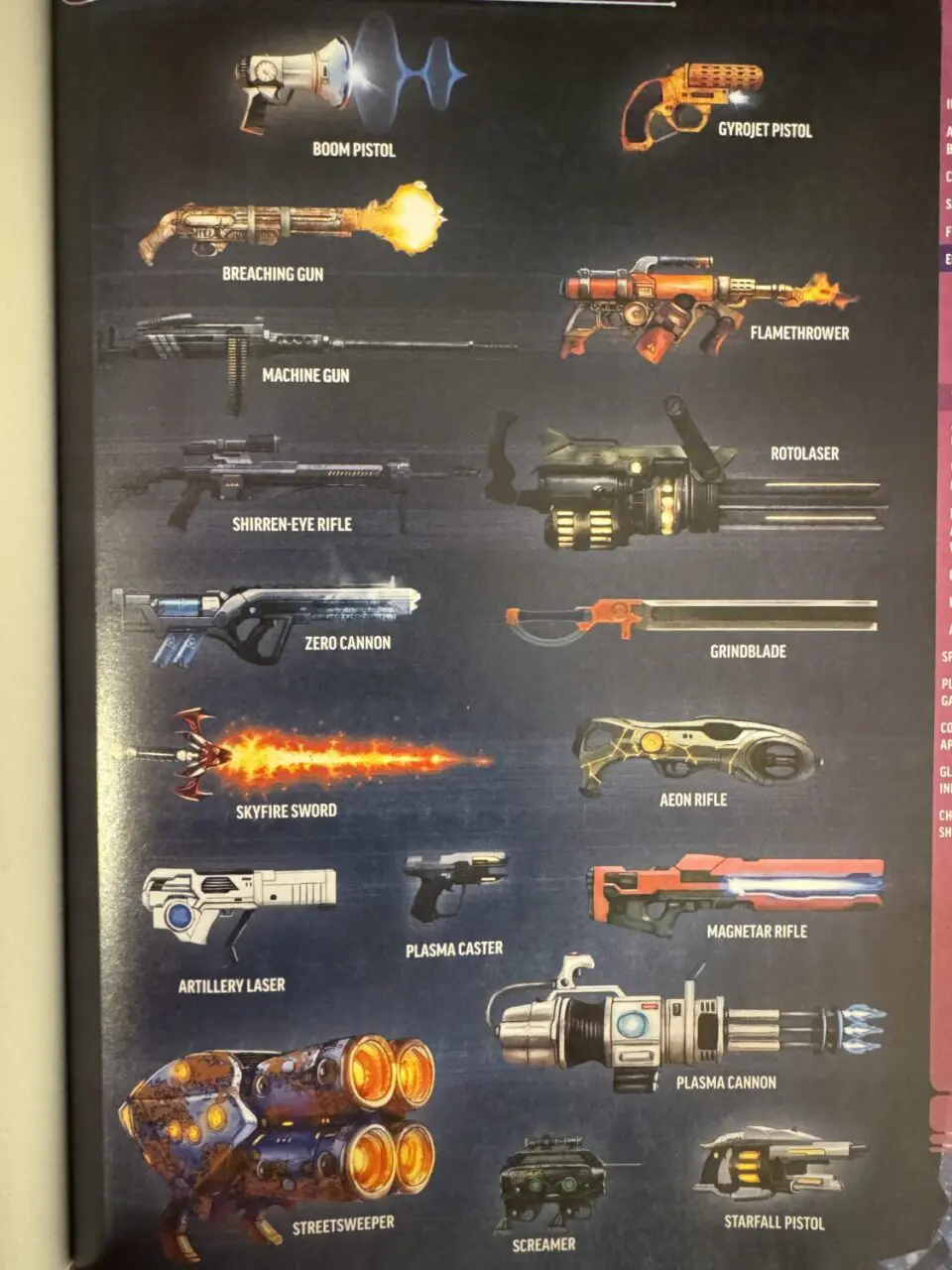
When it comes to equipment, Starfinder Player Core represents a huge step forward compared to the first edition, if only because of how information about weapons and armor is now presented. In the original Core Rulebook, equipment was primarily presented in tables containing the relevant statistics, while brief item descriptions appeared several pages later. Now, descriptions are provided immediately, and the tables follow a consistent structure that includes item traits, the number of actions required to reload, the number of hands needed, and other parameters.
Thankfully, grenades have also been moved into their own equipment section, so there's no longer any need to sift through a table where the same Range, Capacity, and Bulk values are repeated for more than 30 different types of grenades. As a result, the equipment section is much cleaner, easier to understand, and more convenient to use.
Another conspicuous omission from the book is that the starship combat rules have been removed entirely! For a science-fiction game centered on planetary exploration, the absence of starship rules seems like a serious drawback, but this system genuinely needed a complete overhaul.
In the first edition, starship combat felt like an entirely separate game, more akin to a tactical miniatures skirmish in which character mechanics had been somewhat awkwardly adapted to specific roles aboard a ship. Furthermore, running these encounters using Theater of the Mind was considerably more difficult, as the numerous moving parts and maneuvers practically required a game board to keep track of everything happening.
Despite the shortcomings of the previous system, I hope starships will return with new, significantly improved rules that integrate more naturally with the core game mechanics.
Navigating the new book is also much easier than in the first edition. In Pathfinder Second Edition, Paizo introduced an improved system of page-margin tabs that display the major subsections as you progress through a chapter. For example, when opening the Equipment chapter, you'll find subsections such as Introduction, Tech Gear, Armor, Shields, Weapons, Armor Upgrades, Weapon Upgrades, Precious Ammunition & Weapons, Grenades, Magic Items, and Augmentations.
This is far more convenient than flipping through page after page, hoping to stumble upon the Tech Gear heading.
Combined with other usability improvements, such as the system of trait tags, more compact statblock templates, and clearer visual distinctions between different types of game-mechanics text, Starfinder Player Core has become—dare I say it—a reference book that's genuinely enjoyable to read.
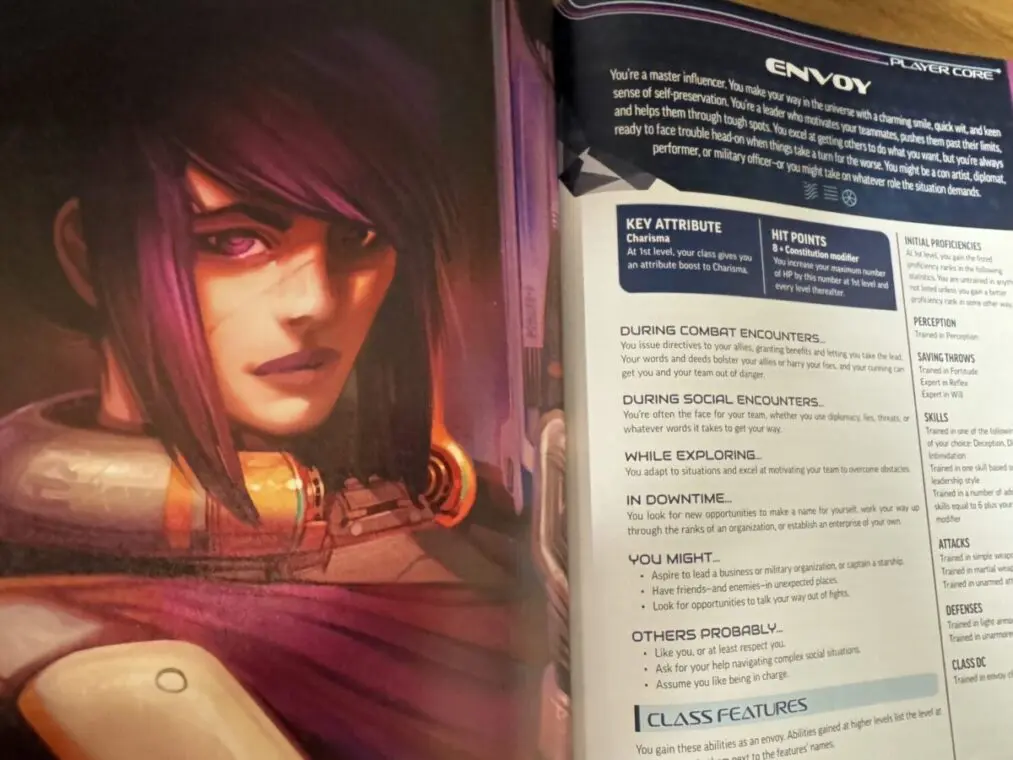
NOTEWORTHY OBSERVATIONS
While reviewing the class material, I noticed a few other interesting details. I should point out that I didn't participate directly in the Starfinder playtest. Instead, I only followed the discussions and new material occasionally as they appeared.
I don't claim to be an expert on this system, much less on a book that has only just been released. So the following observations are simply notes on a few things that caught my attention.
Let's start with the Envoy's Get 'Em directive. In Starfinder Second Edition, the former Improvisations are now called Directives, and Get 'Em has undergone some fairly significant changes.
Its basic effect remains the same: by spending one action, you grant yourself and your allies a +1 status bonus against a chosen target until the start of your next turn. However, you can now use this directive as a two-action activity, additionally making a Strike against that target. In this case, you and your allies also gain a +1 status bonus to damage from other Strikes against it.
Previously, gaining this damage bonus required reaching 6th level and spending a Resolve Point, so it's now much easier to take advantage of.
On the other hand, this means that obtaining the damage bonus requires making a Strike. You generally won't be able to benefit from it while casting a spell, since most spells require two actions. This somewhat limits the class's options, as fully utilizing its signature starting ability requires a character to be at least reasonably competent with conventional attacks.
At the same time, the Envoy gains another starting directive, allowing them to choose abilities that help allies move into more advantageous positions, make enemies Off-Guard, or even switch weapons as a reaction.
Many of these directives also provide additional benefits after making a Strike, but the Envoy still has plenty of interesting ways to strengthen allies and weaken enemies.
I also really like that Witchwarpers can choose between Charisma and Intelligence as their key ability score. This makes an already versatile class even more flexible. Now, your reality-warping character can develop according to your chosen concept rather than being tied to one specific ability score. It's the only class in Starfinder Player Core that offers this option.
Solarians were the class that caught my attention most when the first edition was originally announced. I was intrigued by their ability to fill gaps in a party's composition as needed, serving as a battlefield controller, a heavy damage dealer, or a tank.
However, my enthusiasm faded somewhat during playtesting. Solarians had fairly weak Class DC progression, and one of their signature class abilities, Solar Shot, used Dexterity instead of Strength. An odd decision for a class whose primary ability score is Strength.
Now, Solar Shot has been renamed Solar Flare, and the ability appropriately uses Strength. Additionally, Solarians now reach Expert proficiency at 9th level instead of 13th, and Master proficiency at 17th level. These are truly massive improvements.
Revelations are also gone! Black Hole and Supernova have now become 4th-level class feats. Once again, this makes the class feel as though it has lost some of its uniqueness, since players are now encouraged to build their characters around one of these abilities rather than having them as integral parts of the class.
STARFINDER COMBAT PAD: CONVENIENT INITIATIVE TRACKING IN COMBAT
Alongside Starfinder Player Core, Paizo also released an updated version of the Starfinder Combat Pad. This magnetic initiative tracker comes with a variety of magnets for player characters, NPCs, enemies, hazards, and conditions. Its main purpose is to reduce the mental workload on Game Masters and make combat encounters easier to manage.
My favorite way to track initiative, when I'm not playing online through Foundry VTT, is to divide a sheet of paper into two columns. In the left column, I record the initiative value and the combatant's name, while in the right column, I track Hit Points and other important notes.
If I need to remember an enemy's special ability or mark a particular condition, I use whatever space is available in those columns. This approach works wonderfully for keeping track of the very things I'm most likely to forget.
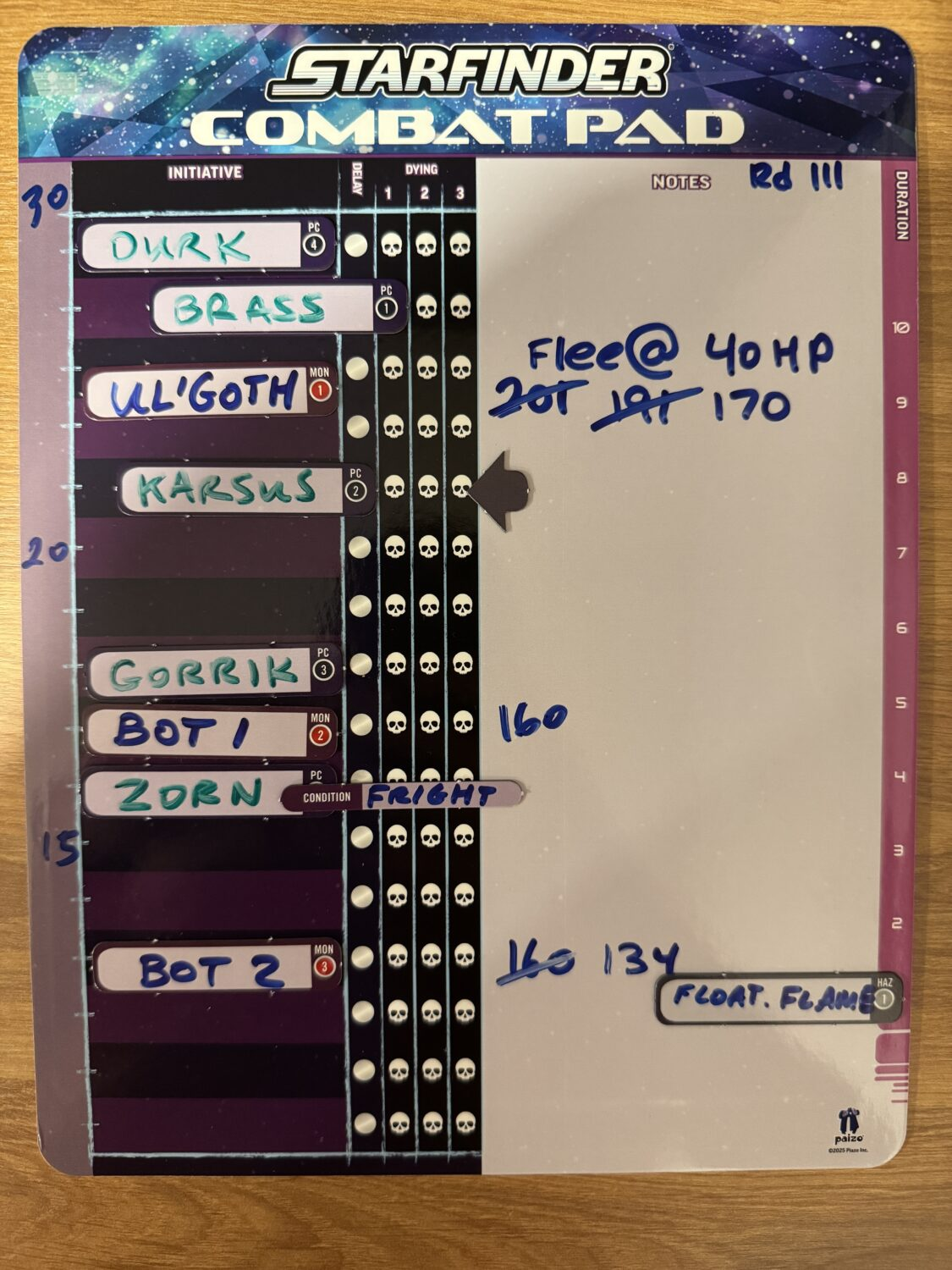
The Starfinder Combat Pad essentially recreates this format, but adds a central section for characters who are Delaying their turns or are in the Dying condition.
The main advantage of a magnetic tracker over ordinary pen and paper is the ability to rearrange characters easily when they delay their turns. One of my biggest frustrations is having to cross out names, squeeze new entries into the margins, and eventually watch all my important character notes turn into a confusing mess. It's a real headache.
The magnetic tracker doesn't necessarily solve this problem completely, but the extra magnets leave room for creativity. I've started writing important notes on blank magnets so I can move them along with the corresponding characters in initiative order whenever necessary.
Now I no longer have to worry about running out of space, and I only occasionally need to rewrite Hit Point values. An alternative way to track health is to create an informal third column along the far-right edge of the pad and use the numbered magnets to indicate enemies' Hit Points.
In terms of design, the new pad is somewhat more functional than the first-edition version. It includes more magnets, offers additional space for notes, and moves the duration tracker—used to monitor abilities whose effects last a certain number of rounds—to the far-right side so it stays out of the way.
The new version also removes the separate Round Tracking counter. After all, you can track the number of rounds on the duration tracker or simply write it somewhere in a corner. There's really no need to dedicate a separate area to it.
One thing I did notice, however, is that the writing doesn't erase completely. I used blue and green Expo markers, as shown below, so I'd recommend keeping a dedicated dry-erase surface cleaner handy.
STARFINDER PLAYER CORE: SHOOT FOR THE MOON
The excitement surrounding Starfinder Second Edition is entirely justified, and I can't wait to see how creatively players combine it with Pathfinder Second Edition.
I recently heard an observation that has stuck with me: Starfinder First Edition was effectively a playtest for Pathfinder Second Edition. I've been thinking about that quite a bit lately, and with the release of Starfinder Player Core, it seems the story has come full circle.
The future of Starfinder Second Edition shines as brightly as the stars, and I'm already ready to set out on new adventures.


