
Dungeons, Dice & Danger Game Review
Related Products
REVIEW
When I think of legendary game designer Richard Garfield, I think of Magic: The Gathering, KeyForge, SolForge: Fusion, and Robo Rally. Oh, and vampires and rabbits. But not bones. Danger, for sure, and sometimes dungeons.
The emergence of roll-and-write from Garfield was only a matter of time, because, after all, roll-and-write (RNW) is an integral part of life in the world of board games today.
I don't think this is a good or bad thing. I've actually enjoyed some roll-and-writes, including Dinosaur Island: Rawr 'n Write and the now-classic Railroad Ink.
My main complaint about the genre is that over the past 2–3 years, the market has been flooded with too many of these games — simplified versions of full-length board games that I liked much more.
That's why Dungeons, Dice & Danger is so appropriate in my home: it's an original design, the game is easy to explain, and it can (and even should!) be played both in a crowded bar and in a noisy home party.
ERASE AND COLOR
Dungeons, Dice & Danger puts players in the role of future heroes who delve into dungeons in search of treasure and a fair share of danger.
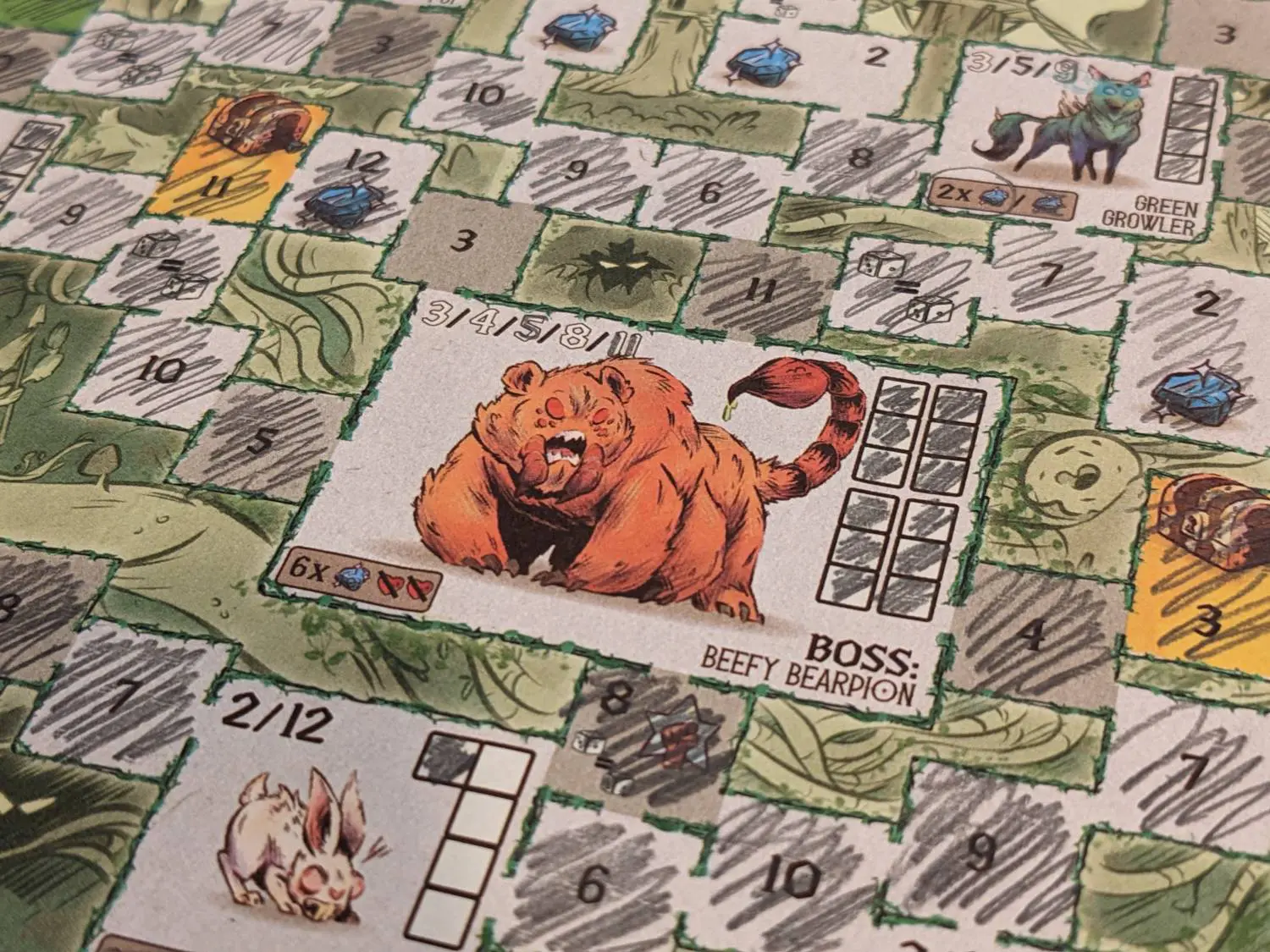
They face this danger by rolling five standard six-sided dice (D6)—four white and one black—and using the results to advance through a dungeon filled with rooms, each with a unique number from 2 to 12.
Before each game begins, players collectively choose one of four available maps, sorted by difficulty level. (The box contains dozens of double-sided sheets, each depicting one of the four dungeons.)
All maps have a similar structure: the green starting cells contain all possible combinations of number pairs, while the other cells lead deeper into the dungeon - with different numbers, dice symbols, monsters, and treasures.
On the active player's turn, he rolls all five dice and can use them to form two pairs. No one moves the dice - the pairs must be formed mentally, without shifting them for each player.
Passive players (or the sole participant in solo mode) can only use white cubes to pair, which gives the active player the most flexibility in their turn.
Starting with the green squares, the move is very simple: cross out the two numbers that correspond to the pairs you made from the rolled dice.
Let's say the white dice roll 3, 4, 6, and 6. Passive players must make pairs of these numbers. For example, I will choose combinations of 7 and 12, although I could also make 9 and 10, etc.
Looking at my sheet, I can cross out a 7 in the green starting cells, and then a 10 if it is adjacent to that 7. Or I can cross out both a 7 and a 10 in the starting cells.
Once a cell is marked, subsequent moves in the dungeon must be adjacent to any cell already marked. When a player marks any cell adjacent to a monster, future pairs can be used to deal damage to that monster if its number matches your dice roll results.
Other tiles can yield gems that add up to points at the end of the game. There are special tiles on the map related to collecting sets, small treasures like gold, and special abilities that give players extra health or access to the black die as a passive player.
(At the beginning of the game, each player can use the black die three times as a passive, but this number may increase during the game.)
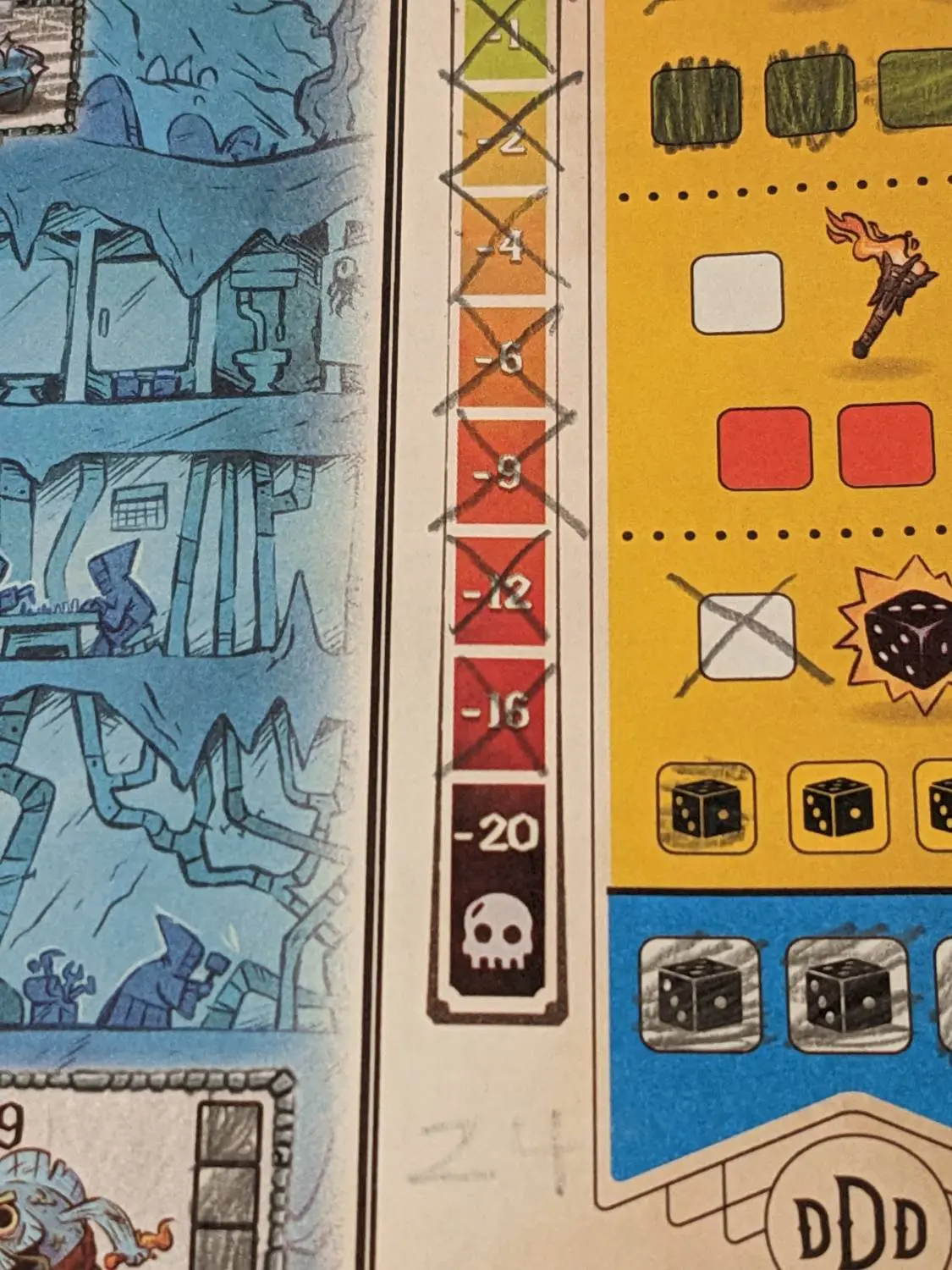
If a player fails to make a pair, they take one damage. Accumulating too much damage will result in players losing a lot of victory points at the end of the game… and if they take enough hits, the character will die in the dungeon and be eliminated from the game.
In my experience, this rarely happens, and this is clearly stated in the excellent instructions for the game.
A game of Dungeons, Dice & Danger ends when the players collectively defeat all the monsters on the map. Damage points are subtracted from the players' total scores to determine the winner—in my four attempts at the game, their score usually hovered around 60–80 points.
THERE IS A HANDLE - I WILL NOT TALK
Dungeons, Dice & Danger has only two permanent flaws, both of which are avoidable.
The first problem, as mentioned above, is the lack of interaction. Dungeons, Bones, and Adventures is a calm, leisurely game. You talk from time to time, sometimes announce that you've defeated a monster (which gives other players a small bonus), or curse everything when someone rolls bad dice combinations and takes damage.
But I found a way around that: add some alcohol. Put on some good hip-hop. Maybe play the game at a great bar near your house with good music, because you really don't have to interact with others much!
The second problem is the length of the game. Dungeons, Dice, and Adventures can sometimes drag on, especially with multiple players. Sometimes you quickly mark two squares that match your desired dice combinations. But many turns (especially when three players are playing) you mark squares on your sheet and then watch as others search for the "best" squares to mark, and no one can do anything until everyone is ready.
The situation is complicated by the slightly oversized maps. When I played a solo game (at expert level, which turned out to be quite comical, because I literally got blown out of the field), I played for about 20 minutes, rolled a lot of dice and finished a drink at the home bar. There were no problems - no one was waiting for me, the turns passed quickly, and I could enjoy the game alone, competing for the highest score.
If everything is organized correctly, Dungeons, Dice & Danger turns into something completely different: a pleasant solo roll-and-write that is good for killing time while the casserole bakes or while the child bursts in with a "very important" question about his LEGOs.
SOLO PLAYING TO MUSIC AND CONCLUSIONS
Dungeons, Dice & Danger is a real pleasure to play with the right accessories. It won't replace some of my favorite roll-and-writes, but the experience was consistently engaging and well-suited for family play, even for younger players, despite the 12+ rating. My six-year-old son took long turns, but he got the hang of it, and after our games were over, he would just pick up a blank slate and play on his own. (Don't worry—the kids weren't given bourbon.)
The illustrations and monster names on each dungeon sheet are quite amusing. The game is so easy to explain that it is suitable for both experienced gamers and those new to the hobby. I sometimes complain that roll-and-write requires more sheets of paper than dry erase boards - no problem there, as I'm definitely not going to play this game 200 times. Kudos to the production team for giving me a little more material than I needed to make sure I had enough.
1 165 грн.
Dungeons, Dice & Danger (ukr)
DESCRIPTION OF THE BOARD GAME DUNGEONS DICE & DANGER Gather your courage, pack your sword, and roll the dice as you journey through the realm in search of treasure and glory. In the roll-and-write game Dungeons, Dice, & Danger, you explore deep, dark dungeons filled with treasure — and infested with monsters! Do you have what it takes to be a hero of legend?..


