Pax Penning Review
Related Products
PAX PENNING GAME REVIEW
Pax Penning, like all games in the Pax series, has its own important themes and ideas. All games in the Pax family focus on political upheavals and periods of significant change. Your task from one game to the next is to adapt as best you can to these turbulent events. Unlike most board games, the pieces on the board in Pax games do not belong to any particular player. You may temporarily control them, but nothing is truly yours or someone else's. Everything is held together by a web of connections and temporary alliances.
Pax Penning isn't part of the official Pax series, which is mostly made up of games from designer Phil Eklund and publisher Ion Game Design, but it's certainly in the same vein. It's well-deserving of the Pax name.
Players represent different families (houses) of the city of Sigtuna around 1000 AD, trying to navigate the political consequences of the reforms introduced by Olof Skötkonung, the first Christian king of Sweden. You will have to decide whether to support him or not.
How you answer this question is presented in such an abstract way that it's easy to forget what decision you're actually making, even though the game's design constantly reminds you of the specific time and place. This also applies to the rules, which contain a lot of interesting notes about the historical period depicted. These notes have another purpose: designer Matilda Simonsson is very aware of how Viking symbolism is used by white nationalists around the world, and she doesn't want her game to suffer the same fate.
As an explanation of the rules of Pax Penning, the manual is well written, but only if you've played the game before. This isn't a problem that's typical of GMT Games' games, where the document serves more as a reference than a tutorial. Pax Penning is simply hard to describe. It's made up of separate mechanics, each of which is fairly simple on its own, but together they form a complex and unobvious system. At its core, it's a game about influence and, in its own way, about negotiation.
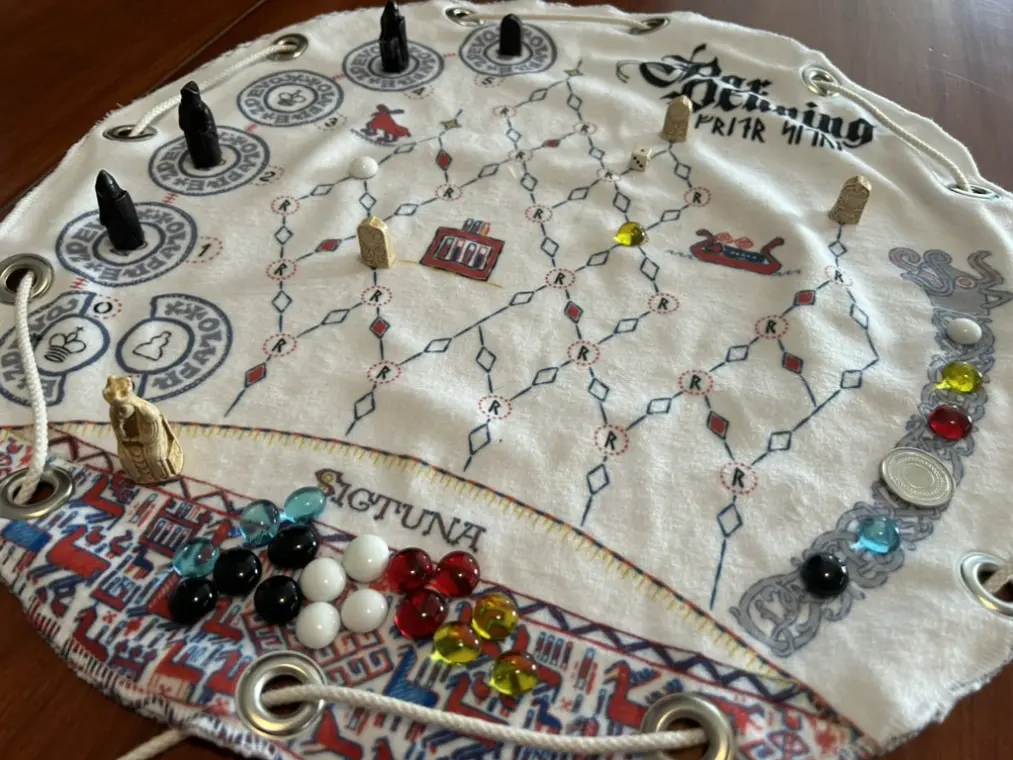
Each player has a screen behind which lies a set of stones. The stones symbolize the influence and changing alliances between different families. During the game, these stones are passed between players or even removed from the game, which can significantly affect the determination of the winner.
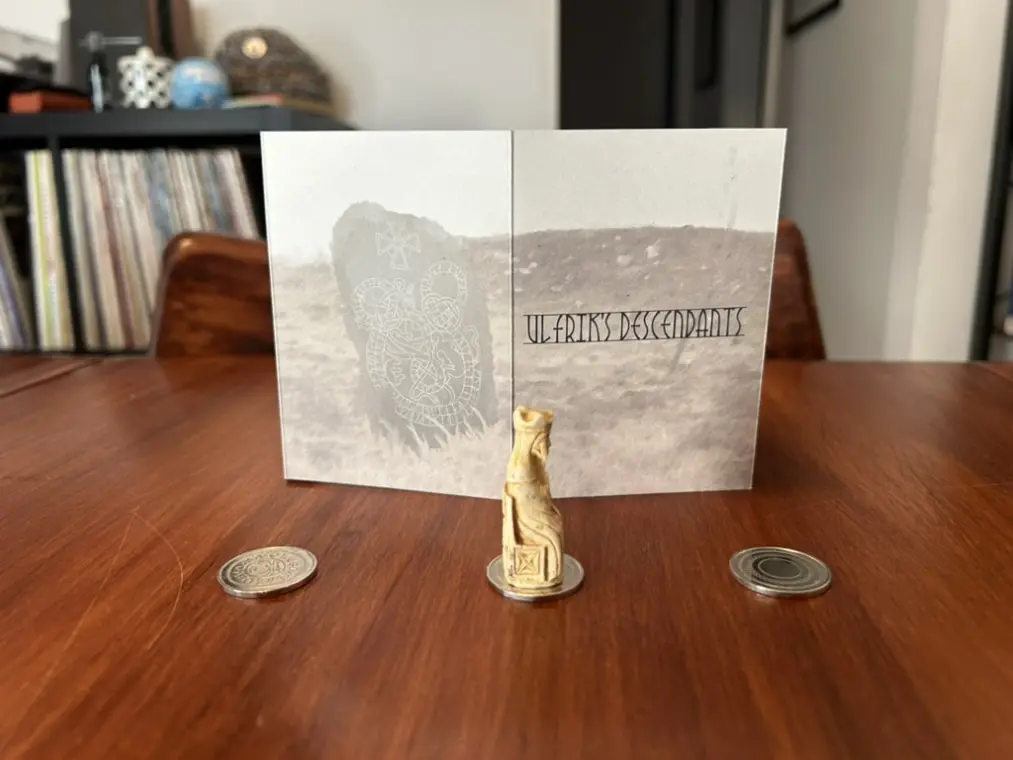
In front of the screen are coins that are not used as currency. They also represent a type of loyalty. The unpainted side, Silver, allows you to roll more dice at the start of your turn. Whenever a pair of identical results are rolled, you may move one stone from your home. It does not have to be your stone - you can also move another player's stone.
The engraved side, Penning, represents loyalty to the king. The number of Pennings you have determines what actions are available to you during your turn.
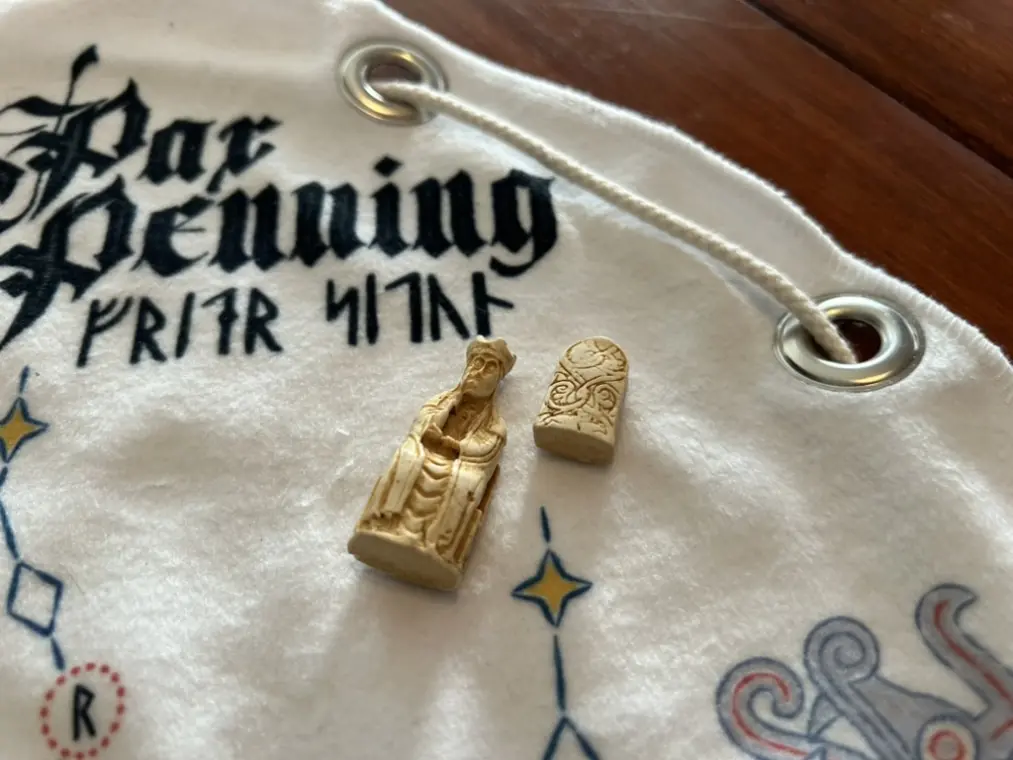
Each action is associated with a magnificent cast resin chess piece. The king, rook, knight, bishop and pawn are all replicas of the chess pieces of the corresponding era, carved from stone. Also striking is the cloth bag that houses Pax Penning and doubles as a playing field, a technique that Mathilde Simonsson borrowed from her game Turncoats.
Overall, Pax Penning's design is very meticulous and detailed, which is why the game makes such a strong impression and perfectly captures the atmosphere of its era.
The actions themselves are not complicated. You can move pawns along paths on the board, which in turn helps move influence stones. You can directly spread influence between Houses, place cubes on the board that symbolize social decline, or change the hierarchy of Houses. This may be a bit of a simplified description, but that's the gist. However, in Pax Penning, the specific actions that make up a turn are not the most important part of the game.
As the game progresses, the king travels through the region, moving in a circle from coin to coin, located in front of the players. Receiving royal honors is certainly a great honor for your House, but it also requires resources. Whether it is Silver or Penning, the coin on which the king and his retinue are located is temporarily not counted for any purposes. Therefore, players are interested in sending the monarch to someone else, but at the same time it speeds up the completion of the game.
The end of the game is perhaps the most confusing part of Pax Penning. There are several interrelated factors that determine when and how the game ends, not to mention who wins. Just one thing: if you want to win, you must have the majority of the stones behind your screen.
If the largest share of stones in your House belongs to another player, that player becomes your heir and takes your victory for himself. But his victory can also be taken by another heir, and then by someone else... In general, the principle is clear.
This creates an extremely interesting dynamic at the table. In a successful game, no player ever feels completely in control. Pax Penning is constantly slipping away. No single element is particularly difficult, but it is extremely difficult to keep all the connections between them in mind and understand how they affect each other.
Despite all the obscurity I've described, and despite the fact that I still can't fully explain how this game works, over time you do learn to "ride the worm," to use that metaphor. You start to feel more confident—or at least confident enough. And then you realize that Pax Penning is, above all else, a very funny game.
When played with five players—and this is undoubtedly its best configuration—it becomes incredibly funny. There comes a point when every decision counts. With the ground constantly slipping from under your feet, you are constantly off-balance. Not so much that you feel completely helpless, but enough that almost every move you make elicits a grumble or curse from someone at the table.
It's certainly not for everyone. But for those who enjoy this style of board games, Pax Penning is a real find. As the game progresses, it gradually unfolds before you. The long-term consequences of your decisions begin to emerge more and more clearly. You finally understand how everything works - and at that moment the game slips out of your hands again.
Pax Penning is a wonderful, expertly crafted game.


