Nerdy Inventions Game Review And Impressions
Related Products
REVIEW
In Nerdy Inventions, players roll dice to collect cards from an open board. The resulting cards are added to their play area (Laboratory) and can be used for their special abilities. These cards allow players to manipulate the results of the dice rolls in future turns to gain more Invention cards. The game continues until certain end conditions are met, at which point players tally up points to determine a winner.
GAME COMPONENTS
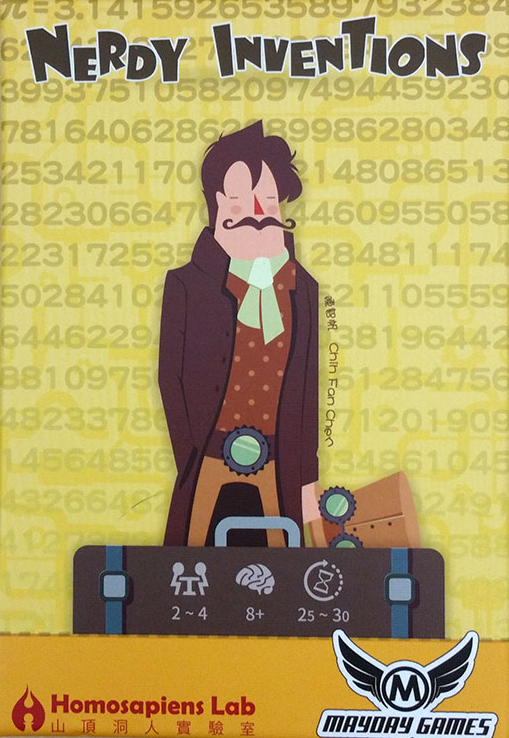
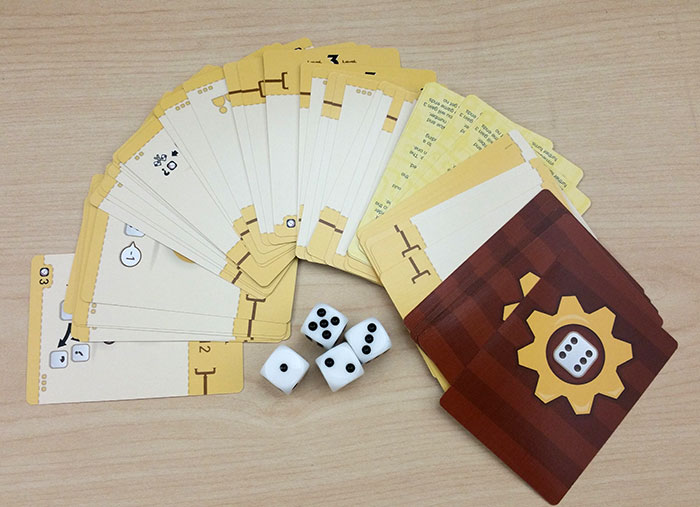
When you open the box, you’ll find an 8-page manual, four standard six-sided dice, and a deck of cards. The cards are divided into different types: Invention cards, Invention starter cards, Tool cards, cards with summary information about card abilities, and dice value cards. The cards are sturdy, with a nice smooth linen texture. The rules are well-written and beautifully illustrated. It’s worth noting that the game was created by Chi-Fang Chen, who also did the illustrations for it. Overall, the look and feel of the game is very aesthetically pleasing, and it really looks beautiful on the table.
PREPARATION
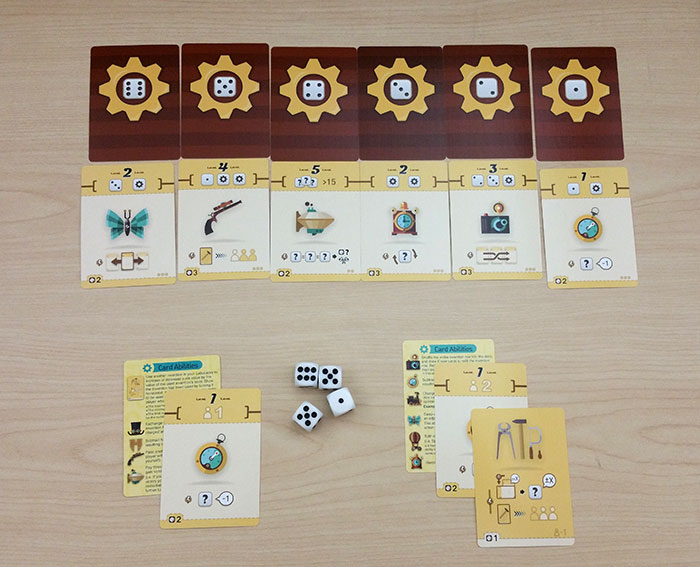
At the beginning of the game, the dice value cards are laid out next to each other in descending order from left to right. The Invention cards are then shuffled and one Invention card is placed face up under each dice value card. The remaining Invention cards are placed face down in a deck next to the newly created row of Inventions.
Next, a starting player is chosen, and each player receives a starting Invention card with their number (clockwise). This card is kept in their Laboratory. Each player, except the first, also receives a Tool card, which they also keep in their Laboratory. The dice are placed side by side, and the game is ready to begin.
CARDS
The die value cards and reference cards are pretty self-explanatory, but it's helpful to take a little time to review the designs and abilities of the various Invention and Tool cards.
Each Invention card has a standard structure. The top of the card shows a number that represents the card's level. Below that are the dice requirements. In the center of the bottom of the card is an iconic description of the card's ability. The bottom left corner shows the number of victory points, and the bottom right corner shows how many copies of that card are in the deck.
Tool cards are designed almost the same, but they do not have a card level value.
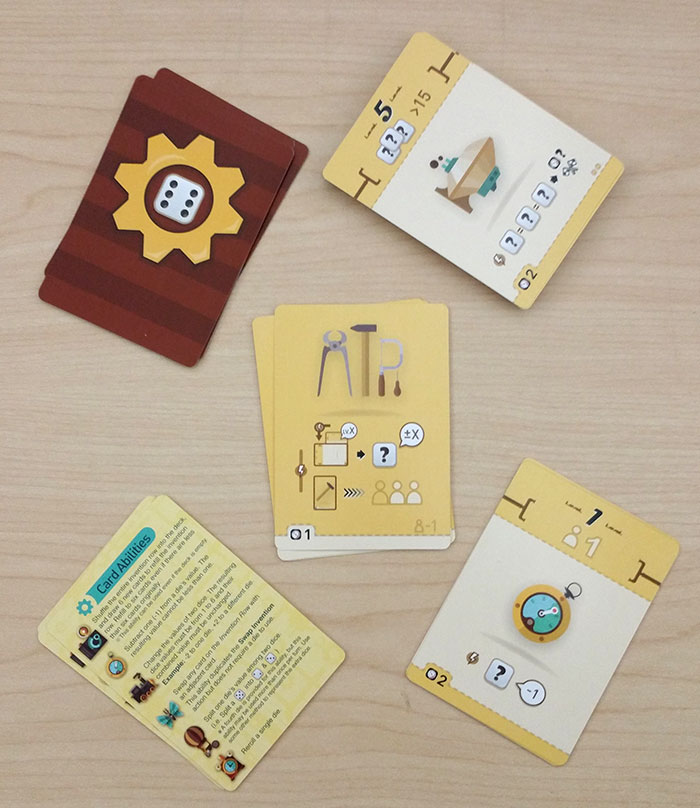
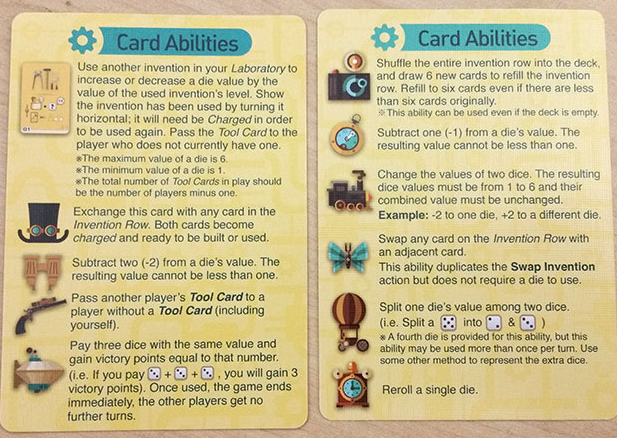
Some card abilities allow you to manipulate the dice: for example, adding or subtracting points from the dice values, rerolling the dice, or distributing the values between the dice. Other abilities allow you to change the order of cards in the Invention row.
Tool cards allow players to significantly alter the results of dice rolls by increasing or decreasing the die value by the Invention level associated with that Tool card's ability. For example, if a player uses a Tool card in conjunction with a level two Invention card, they can add or subtract two from the value of any die they roll that turn. But if a player uses a Tool card, they must pass it to another player who does not have a Tool.
STRUCTURE OF THE MOVE
A player begins their turn by rolling three dice. After that, they may perform any number of the following actions in any order they wish:
- Create an Invention – The player pays the dice requirement of the card and places it in their Laboratory. If the dice requirement has a gear icon, its value is equal to the value on the Dice Value card under which the Invention card is located. The value of a six on the die is a wild card and can be used as any value.
- Use Invention – A player may use the special ability of a previously drawn Invention card. When the card is used in this way, it is considered exhausted and is turned sideways to indicate that its ability has been used.
- Recharge Invention – The only way to use an exhausted card’s ability again is to recharge it. To do this, you need to pay the card’s level with one of your dice. The recharged card returns to its upright position and is ready for use again.
- Swap Cards in the Invention Row – A player may pay a die with a value equal to one of the Dice Value cards to swap the card below it with any of the adjacent Invention cards. In the case of Dice Value 1 and Dice Value 6 cards, there will only be one adjacent Invention card.
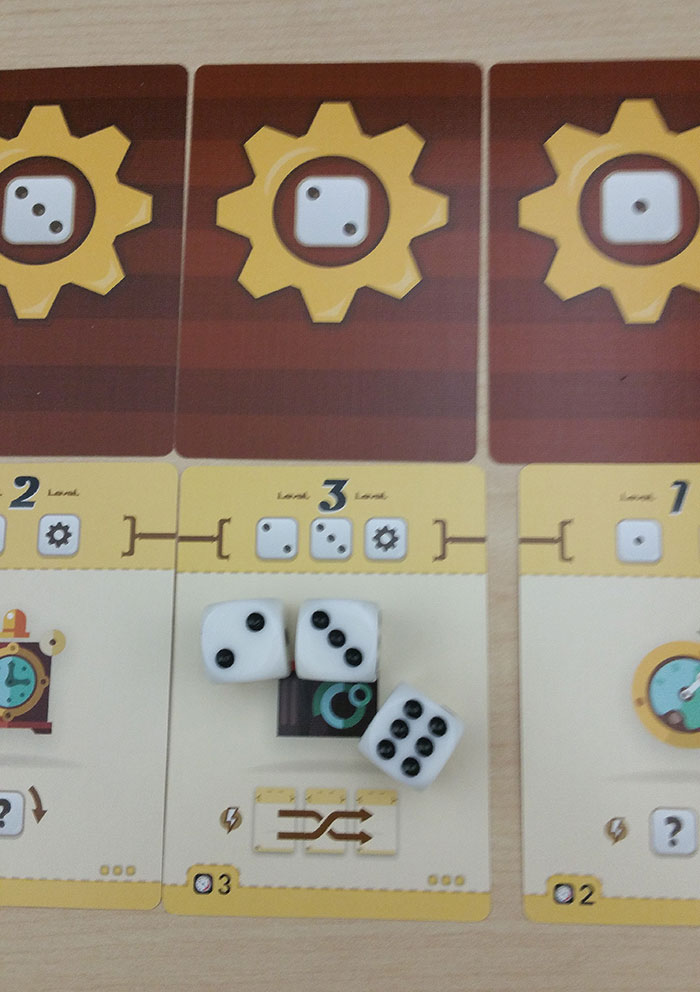
Once a die has been used for any action, it must be set aside. A used die cannot be used again during that turn.
After the active player's turn, the Invention row is replenished. All existing cards in the row are moved to the right to fill the empty spaces. New cards are then drawn from the Invention deck and placed under the now empty Dice Value cards.
END OF THE GAME AND SCORING
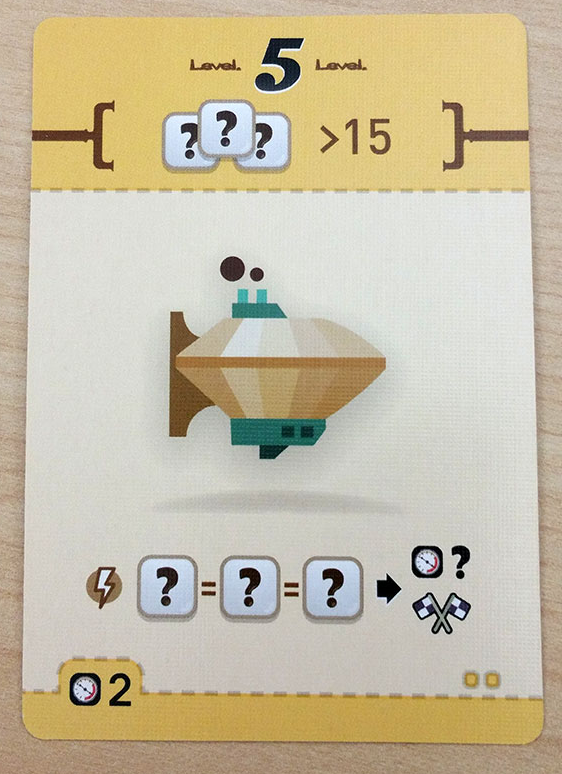
The game can end in one of two ways. First, the game ends immediately as soon as a player uses the submarine ability of one of the Invention cards that allows this action. There is no specific terminology for actions in the game - everything is represented as icons, and this particular action looks like a submarine to me. I'll include a picture of it here so you can see for yourself.
The second way to end the game is when the last card from the Invention deck is placed in the Invention row. In this case, players continue to take turns until it is the starting player's turn. After that, points are counted.
Players receive victory points for each Invention and Tool card in their Laboratory. They can also earn bonus points if they have a large collection of different types of Inventions. The number of points depends on the size of the collection. The player with the most points wins the game.
CONCLUSIONS
My first impression of the game was formed immediately after I opened the box. The minimalist style of the illustrations, the small number of components, and the presence of dice gave me the impression that the game would be very simple and heavily dependent on luck. However, after reading the rules and realizing that the game gives players a way to manipulate the dice, I had hope. Maybe there was more to this game than meets the eye. Maybe the dice manipulation element would add a strategy that was not immediately apparent. But would it be enough? There was only one thing to find out. I gathered a few friends and sat down to play.
As I predicted, dice add a significant amount of randomness to the game. So much so, in fact, that there are sometimes turns where the player rolling the dice literally can't do anything useful for themselves. There's always the option of swapping two cards, but if even then you still can't get either of them - what's the point?
However, when you manage to get new Invention cards for your Laboratory, the game becomes more interesting. Progress is slow at first, as there are few cards to use, but as your collection of Inventions grows, so do the possibilities. If you start the game with a starting Invention card that allows you to subtract 1 from the value of one die, later turns allow you to manipulate the dice much more inventively.
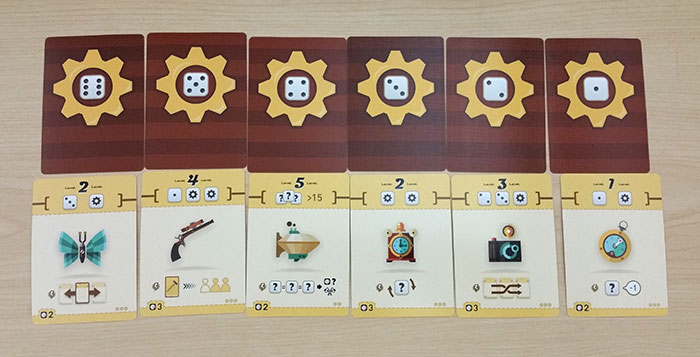
For example, in one game I played, there was an end-of-game card in the Inventions row, and I really wanted to get it. Normally, to get a card like that, you have to roll a total of 15 or more on all three dice. I didn't roll that high, but I had an Invention that I had built that allowed me to swap that card with any other card in the Inventions row. So I swapped the cards and got the end-of-game card.
As I mentioned, the endgame card has an ability that looks like a submarine. To use this ability, the active player must use three dice with the same value on the faces. When the ability activates, the player who used it gets bonus points equal to the value of those three dice. I rolled one die for 4 and two dice for 3. I knew I could use my starting Invention card to turn the 4 into a 3, but that would only give me 3 bonus points. Instead, I used the various cards available to me to flip the dice, swap the Tool cards, and reroll the dice so that all three dice were sixes, and ended the game much stronger than I otherwise would have been. As a result, I managed to use up seven different Invention cards in one turn, which was great.
It is these card combinations that make the game interesting. This small opportunity to control the outcome of the dice rolls gives the feeling that you have some influence on your fate. However, everything is not so simple. There is a certain problem with the pace of the game. At first, the game is slow, a little dragged out, but from the middle of the game the speed increases and the game starts to move much faster. Part of the slow start is explained by the fact that at the beginning of the game there is only one Invention card. Partly - by the need to make decisions and make calculations. This was somewhat unexpected for me, but pleasantly surprised.
Overall, Nerdy Inventions is a pretty solid little game. It's certainly not the deepest or most strategic game you've ever played, but it's got enough thought to keep the player interested. Plus, the simple rules and short playtime make it a great filler game. While it's not a game I fell head over heels in love with, I liked it enough to agree to play if invited.