
Got Five! Game Review
Related Products
Every now and then I sit down to play a game with no expectations. I don't expect to be thrilled or disappointed. I'm completely indifferent—a blank slate. I consider that a truly neutral reaction, although it occurs to me now that I generally like trying new games, so indifference is actually a mildly negative reaction. I'll think about that another time.
That's how I felt about *Got Five!*, a deductive game from designer Joanne Levé and publisher Blue Orange. I picked up a review copy because it was the "off season," I knew the game wouldn't last long, and I loved the tiles. I don't know which of the two artists—Mathieu Closs or Simone Douchy—was responsible for their design, but it's hard not to love these colorful Bakelite "tombstones" with expressive eyes.
Don't be fooled. Behind their friendly exteriors lie scary secrets - namely the numbers 1 to 60. If that doesn't sound scary to you, then you probably love math. To set up the game, each player takes one tile of each of the five colors and places them so that the numbers are visible to everyone else at the table. It's extremely important that you don't see the numbers on your own tiles, as the goal of the game is to figure out which tiles you have.
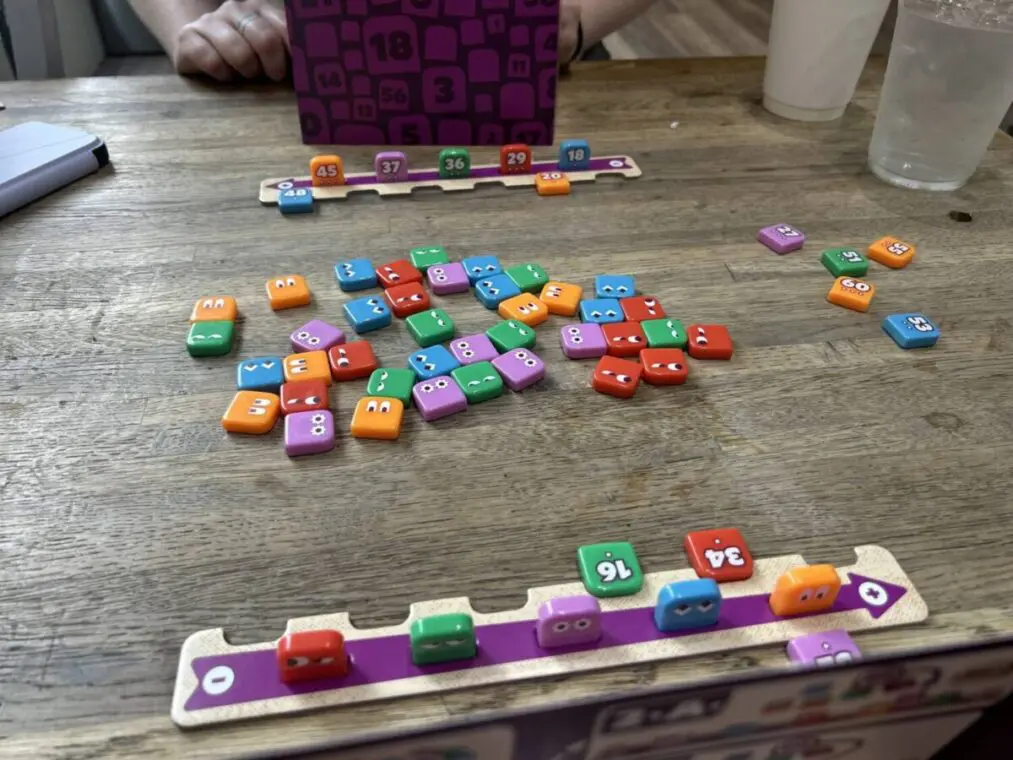
Each player's five tiles are laid out in sequential order by another player. Very kind of him. One of the best things about *Got Five!* is how disciplined the game is in dispensing information. Even without looking at the other players' tiles, your neatly arranged row already gives you some clues. In *Got Five!*, the numbers are evenly distributed across five colors, and each player has a marker board hidden behind a screen where they can see all the possible options and mark off what they already know. If my lowest number is an orange tile, which can be any fifth number from 5 to 60, then I already know that 1–4 are not suitable for the other tiles, and I also know that my orange tile will definitely not be 60.
Add to that the information provided by the other players' revealed tiles, plus the five additional tiles revealed during setup, and there are a lot of inferences to be made right from the start. In a four-player game, this is probably my favorite part of *Got Five!* - those two or three minutes when everyone is processing the initial set of information. It's an incredibly rewarding feeling. If the starting tiles are well-placed, the chain of logical inferences can take you much further than you expect. In a four-player game, it almost feels like you can guess the right answer right away if you're smart enough. Of course, it's impossible, but that feeling is very exciting.
Once that's done, the actual game begins. Players take turns turning over one of the face-down tiles in the center of the table and adding it to the starting set of five. The active player chooses one of the six tiles in that set. He then either places it in front of his row of "mystery" tiles and says, "Sort," after which the other player places the chosen tile where it should be on the number track; or he says, "Compare," after which the active player holds the chosen tile next to any of his tiles and waits for an answer. There are one to three dots under each number, and the Compare action lets you see if the tile in your hand and the tile next to it have the same number of dots.
The structure of each turn is simply wonderful. You can win at any moment, even on your turn, by shouting "Got Five!" and correctly naming all five of your tiles. Because of this, the beginning of each turn - the moment of revealing a new tile - tenses everyone at the table. The active player is simultaneously desperate for a lucky coincidence - once a revealed tile allowed me to immediately eliminate 12 other options - and at the same time afraid to give such luck to someone else. When this moment passes, each player learns something that will help only him.
The box of *Got Five!* mentions bingo—and rightly so. There's something compulsive, gambling, almost like a betting parlor about the game. You're not splitting atoms here. This is not *Hooky.* You don't want to go to sleep after a game. But the game still makes you feel smart—and in a way that makes you want to play it again right away.
Are there any flaws in the game? Of course, there probably are. If you view board games solely as a competitive experience, rather than a social one, you will have problems. A lot of it depends on luck. Clusters of numbers or extreme values can lead to an answer very quickly, while an even distribution takes longer. It often happens that one player shouts G(o)t Five! at the very turn when the others were already one step away from winning. After a game or two, you will see all the secrets of the game. All of this is true. But what a boring way to look at things. I scold myself for even thinking about it. God, *Got Five!* is so much fun in a game.


